17 May 2010

Alan Egan - South African Painter


Allen started to paint in oils at the age of 17, and went on to study graphic design at Harare Polytechnic. He then worked as a Graphic Designer, which he believes was good formal training in the elements of layout and design, elements that Allen feels are important in his paintings today.

Allen moved to Port Elizabeth in 1990, and soon opened his own silkscreen and manufacturing business. Through the years Allen continued to paint, occasionally holding exhibitions or participating in group or local exhibitions in Harare and Port Elizabeth.

In April 1999, Allen married and moved to Bloemfontein to join his wife, Kirstin. The couple decided to sell Allen’s business interests after several successful years, to allow Allen to begin painting on a full time basis.

Until recently Allen painted wildlife and explored and experimented with abstraction. However with the opportunity to paint full time, Allen has started to explore the human form. Working from photographs, he explores and exploits the human form in great detail. Allen has chosen to paint the people of rural South Africa as he enjoys subtly depicting the obvious hardships of rural lifestyles. He believes these hardships can be seen in the hands and faces of rural people. There is a texture to the lives of country people, which Allen finds fascinating most probably a result of the fact that it is a lifestyle and culture different to his and to that of many other South Africans. Although rural lifestyles have been recorded photographically, Allen believes that this subject matter has not been well recorded - certainly on a contemporary level - from an artist’s point of view.

Angus Taylor Sculpture


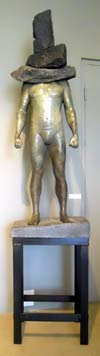
Taylor has developed a solid reputation for his accomplished and humorously ironical bronze sculptures. Now he wishes to dislodge himself from his previous comfort zone in terms of sculptural techniques and materials, and in so doing, hopes to strip away the polished surfaces of the finished piece to reveal the physical and mental processes involved in its making.

Taylor works from the premise that deduction gathers a valid conclusion from a more general premise to a more specific. The process of induction involves drawing general conclusions based on a limited and specific inference. Thus, in a technocratic culture that favours simulation and speed over real-time relationships, people and things are reduced to quick-time taxonomies.
Deduction implies the opposite. To deduce involves reasoning from the general to the particular, underscoring the need to engage with culture in terms of its flexible morphology. In this body of work, Taylor attempts to peel away the surface of his art to explore its innards, forcing the viewer to engage with the process of art making. He says in this regard: “Information overload causes the domination of inductive reasoning. I am presenting the sculpture or an idea in aspects, perspectives or in different mediums. By showing a sculpture in repetition but a variant with different defined parts or perspectives I am forcing the viewer to assemble the whole from different aspects. One gains access to the part in considering the whole. The collective defines the individual. For, in the words of Meyer Vaisman, ‘…there is nothing more meaningful than taking meaning apart”.

In this way, the induction / deduction binary is conflated in Taylor’s work which, as a collection is both scopic and expansive. Together, his use of a traditional medium like bronze with the plastic form of LED lights pokes fun at old and new canons. This exhibition, in other words, plays with the cultural and art-historical tropes of meaning making in contemporary Africa.

15 May 2010

Theo Megaw - Master Sculptor


An interview with Polly Anderson.

Theo Megaw is a recluse. He lives and works between the slumbering mountains and the wide skies at the southern tip of the African continent. Follow the ragged thread of road that is Prince Alfred Pass and you come to his place. The cottage is built of earth and rough brown stones from the mountains. It was a ruin when Megaw first came to it. Using pine from the coastal plantations he put in a floor, ceiling, doors and windows and put in pipes for water from a mountain stream.

I understand you don’t like talking about yourself. May we talk about your work?
Personal details are so boring. Just about everyone is born; just about everyone is sent to places where they are supposed to learn. And everyone these days is a world citizen. So what can possibly be of interest except their work?

Why do you sculpt?
I just do. It comes out of me, through my hands. I suppose if I think about it I could say I like being in the presence of solid form. It has a grounding effect. My hands like making. And I like moving while I work. I like bending and reaching and hammering and lifting and being on my feet all day. There’s a lot of movement needed to bring about the stillness of a piece of sculpture.

Creating form for me is an organic process. I strive to evoke feeling. If it does not express feeling, any art form, music, painting, writing, sculpture, to me is nothing. I don’t want you to think about my sculpture. It’s a gut reaction I want. You like it or you don’t like it. If you like it, it’s a good piece. If you don’t like it, it isn’t. It’s simple. You don’t need a lot of yammer about a piece. After all, there it is, in front of you. It is what it is.
I see pieces in bronze and stone and wood and steel.

Which is your favourite medium?
My favourite medium is the one I’m working on at that moment. Each medium is right for a certain mood-of-work, a certain feel, a certain tempo. Clay is right for fast, fiery work. Stone, on the other hand, is right for a slow, ruminative approach; shall I make this a little more concave? Shall I make that a little more convex? With steel you work everything out - you calculate and cut and fit. Wood - you fall in love with the sensuousness of colour and grain and the feeling of longness - the tree wants longness. Squatness belongs to stone.

There’s nobody for miles around here. Who buys your sculpture?
There is a very good gallery in Knysna that has my work - Knysna Fine Art

I thought artists have a rather jaundiced view of galleries?
A gallery that you have a good relationship with, that promotes your work, sells your work, is part of your whole artistic endeavor. You can’t do all that as well as make your sculpture. Most artists, including me, don’t know how to sell their work. No. The two go hand in glove - the making and the selling. And you’ve got to sell to go on making. Sculptures of mine have found resting places across the globe - from Canada to Australia. A piece of sculpture needs a resting place - a very physical, spatial environment to be in.

And what of Turner Prize winners?
Well, I see man as a spiritual being (woman is even more spiritual) and art is an expression of that spirituality. And, how shall I put this? - it is to the extent that an artistic impulse expresses that spirituality that sculpture, say, is art. Making a mould of a dull suburban house and casting a replica in concrete is a banal and trite activity - not art. Neither is a dead sheep in a glass box. Neither is a soiled bed and filthy knickers. Trite gimmicks, yes. Poor Turner. Poor Tate. Poor judges. Poor mankind.

Does a client say ‘I want this or that’?
People come to me and say – we’d like something for our garden. Then one day, I go to their garden and we walk around and sit in it and talk. Perhaps something there or there; light, to contrast with the shadows of trees. Or dark, to blend with the shadows. Nobody knows what it will be yet. I have a feeling though; the piece should be squat and rugged or it should have a sense of upward movement.
I go back to my studio and make crayon sketches on large sheets of paper - just a few lines with a shadow here and there - just enough to suggest an idea. Maybe ten or twenty sketches. For one client, their living room floor was covered in sketches; we had to do a kind of hopscotch between them.
After a week or two, we reach a point in our discussions that satisfies us both. Sometimes the process is quick, sometimes it’s slow. Then I start work.

By making a maquette?
I avoid making maquettes. I like working direct. All your energy, insight, feeling for form and texture goes into that first creation. Then copy it, only bigger? I’m bored even before I start.
A while ago a client thought she would like a modest waist-high figure on one side of the garden. Slow metamorphosis took place over weeks as we talked. The finished piece was a kind of fantasy-tree over three metres tall, in the centre of the garden.

The unveiling took place one evening. There was champagne and modern dance and a string quartet and Russian poetry. It was touching. Sometimes you put up a piece and it stands there and you think the owners have forgotten about it.

I see what Megaw means. In a corner stands a bronze figure, almost lifesize. It is simple and quiet, slim and vertical with just a suggestion of the tip of the hair and the edge of the long dress being flicked by a light air.
By contrast there is his group of four lifesize otters - low, squat. There is movement in the simple, sleek forms, the patina grey-green to suggest the watery element which is their home.


Your inspiration - where does it come from?
A mass of cloud, a wisp of cloud. Breathing fresh mountain air. Sunlight on a rough tree trunk. The curve in a neck between shoulder and ear. A Brahms clarinet and piano sonata. It doesn’t have to be visual. A particular woman’s body. An impala. Allowing myself to be inwardly quiet - to make my...call it my connection with the universe. Sometimes the period of quiet is a day, sometimes it’s a week.

May I ask, how old are you?
Old? See this (he tugs at an eyebrow). It used to be ginger. And this (he tugs at this beard).

What would you like to be doing in the next few years?
I’d like to become a Formula One driver. I think I’d be pretty good.